

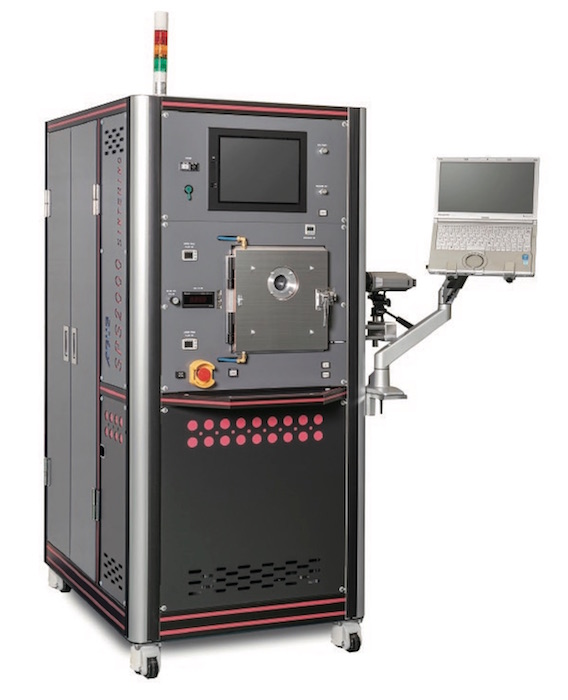
Overview
The SUGA SPS 2000 represents a significant leap in spark plasma sintering technology, combining fast heating, short sintering cycles, and exceptional material densification with innovative process control features — including degassing, rapid cooling, and selectable waveforms for unprecedented flexibility in advanced materials development.
The first generation of SPS sintering technology was introduced to Europe in 1998, with Stockholm University in Sweden being the first customer. Over the years there have been a number of significant development steps based on the first design: most importantly, a new Pulse generator technology and an additional new method to generate Force have been developed, which has allowed for more flexible and cost-effective systems. Developments within electronics, computers and programming have made the operation and control of SPS apparatus much easier and safer.
The SPS 2000 is a sintering platform engineered for high-quality material synthesis across metals, ceramics, composites, and functionally graded materials (FGMs). Spark plasma sintering (SPS)—also known as pulsed electric current sintering (PECS)—applies pulsed direct current directly through the powder and die, enabling sintering at lower temperatures, in shorter times, and with superior material properties compared to conventional hot pressing or pressureless sintering.
Building on over 20 years of SPS experience in European research institutions, the SPS 2000 incorporates a new pulse generator technology, improved force generation, and advanced electronics that make operation safer, easier, and more controllable. The system is ideal for R&D in universities and research institutes where quick experimentation with minimal powder consumption and low cost per trial are critical.
Unique New Features
- Selectable pre/post-sintering process modes: Automate degassing, rapid cooling, and other steps before and after sintering.
- De-gassing mode: Remove impurities from powders using vacuum and controlled heating prior to sintering.
- Rapid cooling mode: Cooling gas is blown onto the die after sintering for shorter cycles and better process control.
- Selectable Wave Forms: In addition to DC Pulse, also Continuous DC and Full Wave DC.
- Fine force control: Down to 200 N for very small and/or expensive powder samples.
- High vacuum: Down to 0.0005 Pa with Diffusion or Turbomolecular pumps.
Key Advantages of SUGA SPS Systems
- Applicable to a wide range of materials: metals, polymers, ceramics, intermetallics, composites, and FGMs
- No special sintering expertise required — intuitive touch panel and automated control sequences
- Enables synthesis of materials previously difficult with conventional techniques (high-strength porous materials, active metals, composite systems without additives)
- Microstructure-controlled sintering through pulse ON/OFF control and flexible sintering parameters
- Safe, user-friendly design with comprehensive interlocks and rapid large-current operations
- Robust, reliable design proven over decades of high-temperature, continuous-duty industrial applications
- Compact, space-saving design that fits limited laboratory space
Selectable pre/post sintering process modes
In addition to the regular sintering control, the following modes can be selected and automatically controlled in a series of operations (read further under “De-gassing mode” and “Rapid cooling mode”):

De-gassing mode
SPS 2000 is the only SPS system that incorporates the DEGAS mode (powder cleaning step):

Rapid cooling mode
Rapid cooling of die/punch/sample after sintering:

Selectable Wave Forms

Originally SPS technology operated with ON/OFF pulses, which could trigger sparks between powder grains. This is the fundamental principle of the success of SPS over conventional sintering techniques.
Now our SPS 2000 introduces two new waveforms: Continuous DC and Full Wave DC. In short this means that the second half of each period, which is negative in voltage sign, is inverted to positive voltage. Initial experiments indicate that this gives a new tool to fine tune optimal parameters for high entropy materials, for example mixtures of many different types of powders.
Block diagram

Dimensions

DC Pulse Generator Upgrade
The SPS 2000 is easily upgraded to higher sintering power. The pulse generator can add modules of 500 A up to a maximum of 3000 A. The internal design is ready-made for the highest current: bus-bars, cables, connectors or other components do not need to be changed.

Overview of features

Technical Specifications
| Model | SPS 2000-3T | SPS 2000-5T | SPS 2000-7T |
|---|---|---|---|
| Max. pressure | 30 kN | 50 kN | 70 kN |
| Min. pressure | 0.2 kN (20 kgf) | ||
| SPS current | 1000 A | 2000 A | 3000 A |
| Stroke | 150 mm (open height: 200 mm) | ||
| Max. temperature | 2500°C (working temp. 2200°C) | ||
| Pressurization system | AC Servo motor | ||
| DC Pulse control | ON/1~999 ms OFF/1~99 ms | ||
| Vacuum chamber | Rectangular-shaped water-cooled system | ||
| Vacuum speed | 2 Pa / 5 min | ||
| Main unit weight | 600 kg | 725 kg | 850 kg |
| RP pump weight | 27 kg | ||
Option
| High vacuum | DP (Diffusion Pump) | ≤ 5 × 10⁻⁴ Pa |
|---|---|---|
| TMP (Turbo molecular pump) | ||
| Radiation thermometer | For temperatures above 600°C | |
| PC for data logger | Windows notebook with mounting arm | |
| Chiller | For cooling water | |
Utility
| Model | SPS 2000-3T | SPS 2000-5T | SPS 2000-7T |
|---|---|---|---|
| SPS current (standard) | 1000 A | 2000 A | 3000 A |
| Power supply | 3φ 200/380/400/480 ±10% 50/60Hz | ||
| Rated input | 18.2 kVA | 32.2 kVA | 46.2 kVA |
| Input cable | Length: 5 m (User side unconnected) | ||
| Exhaust duct port | NW25 (KF25) Flange | ||
| Required space (incl. maintenance) | W1300 × D1600 × H2500 mm | ||
| Cooling water amount | ≥ 10 L/min | ||
| Cooling water pressure | 0.2~0.3 MPa (back pressure ≤ 0.05 MPa) | ||
| Cooling water temp. | 15~30°C | ||
| Cooling water port | Rc3/8 | ||
| Compressed air pressure | 0.5~0.8 MPa | ||
| Compressed air port | Rc1/8 | ||
Video Demonstrations
We are happy to announce a series of four new video presentations of the SUGA SPS 2000 with expert Dr. Lars Hälldahl, PhD.