

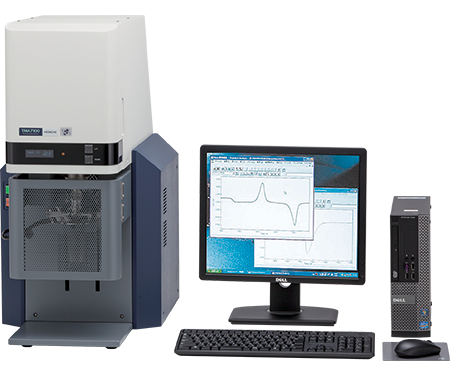
Overview
The Hitachi TMA7000 series measures dimensional changes in materials as a function of temperature and time, delivering high-sensitivity thermomechanical analysis across a wide range of sample types and measurement modes — from thin films to high-temperature ceramics.
Thermo Mechanical Analysis (TMA) characterizes how a material expands, contracts, or deforms under a defined load or atmosphere as temperature changes. It is widely used for determining the coefficient of thermal expansion (CTE), glass transition temperature, softening point, and dimensional stability — both in product development and quality assurance.
The TMA7000 series features newly developed Z-stabilizer signal optimization technology that cuts noise levels and doubles sensitivity compared to conventional models. This makes the series particularly well suited for thin films, low-expansion materials, and small samples where conventional instruments lose resolution. Measurement modes — including push, penetration, and tension — are changed simply by swapping the probe, and the total expansion method places no restrictions on sample geometry.
An improved temperature control function minimizes the gap between programmed and actual sample temperature, ensuring accuracy across the full range. Flexible cooling and atmosphere control options allow the system to be configured for a broad spectrum of applications.
Key Features
- Z-stabilizer signal optimization technology for doubled sensitivity and ultra-low noise output
- Wide TMA measurement range of ±5 mm and load range of ±5.8 N for versatile sample testing
- TMA sensitivity of 0.01 µm — suitable for thin films, coatings, and low-expansion materials
- Simple probe exchange between push, penetration, and tension modes — seven probe options available
- Total expansion method with no restriction on sample shape
- High-temperature, high-humidity measurement option for swelling and moisture-related studies
- Vacuum measurement capability for controlled atmosphere work
- Eco-friendly cooling: LN2 consumption reduced by up to 40%; electrical cooling (no LN2) also available
- Integrated mass flow controller for precise purge gas switching and programmed flow rate control
- Stress-strain measurement support including creep/recovery, stress relaxation, and dynamic viscoelastic analysis
- NEXTA TA software with intuitive simple mode, automated sample length measurement, and compliance with ISO, ASTM, DIN, and JIS standards
TMA7100 and TMA7300
The TMA7000 series includes two models covering different temperature ranges:
- TMA7100: −170 to 600°C — quartz or metal sample cylinder; full probe range including tension mode; suited to polymers, films, adhesives, and electronic materials
- TMA7300: Ambient to 1,500°C — alumina sample cylinder; designed for ceramics, metals, glass, and advanced inorganic materials requiring high-temperature characterization
Typical Use Cases
- CTE (coefficient of thermal expansion) measurement and Tg determination in polymer films and laminates
- Softening and penetration testing for comparative ranking of polymer grades
- Anisotropy evaluation of oriented films under tension in machine and transverse directions
- Creep, stress relaxation, and dynamic viscoelastic behavior of flexible and rigid materials
- Dimensional stability testing for quality control and outgoing inspection
- High-temperature sintering and shrinkage characterization of ceramics and inorganic compounds
Compare Models
| Parameter | TMA7100 | TMA7300 |
|---|---|---|
| Sample Cylinder | Quartz, metal | Alumina |
| Temperature Range | -170 to 600°C | Ambient to 1,500°C |
| TMA Measurement Range | ±5 mm | |
| TMA Sensitivity | 0.01 µm | |
| Load Range | ±5.8 N | |
| Scan Rate | 0.01 to 100°C/min | |
| Maximum Sample Size | Expansion/penetration: Φ10 × L25 mm; Tension: W1 × T5 × L25 mm | Expansion: Φ10 × L25 mm |
| Sample Length Measurement | Automated | |